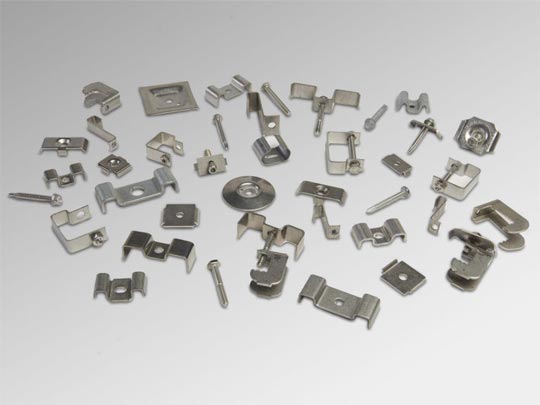
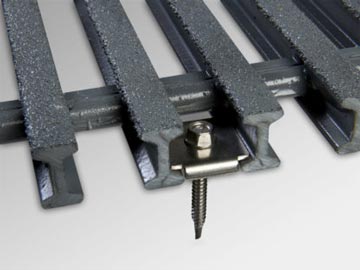
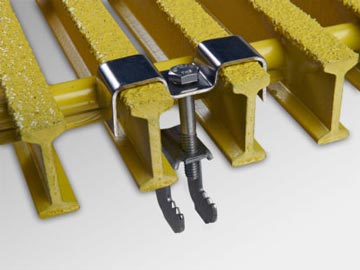
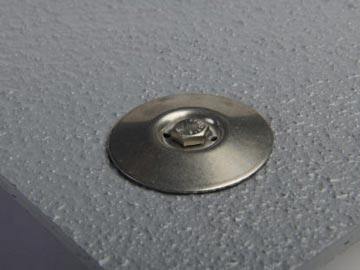
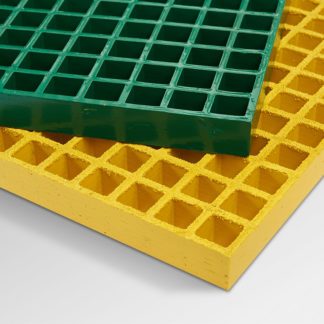
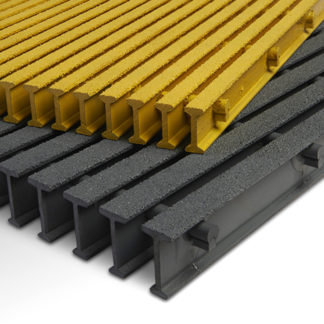
All FRP grating should be securely fastened to its supporting structure to protect the grating and increase product service life. Specialty clips manufactured from type 316 stainless steel are available for all fiberglass products. Clips can be used to attach grating or plate to the supporting structure or fasten adjacent grating panels to minimize load induced differential deflection.
Maximum recommended clip spacing is 48 inches on center with a minimum of four (4) clips per piece of grating.
Fiberglass Grating Fasteners
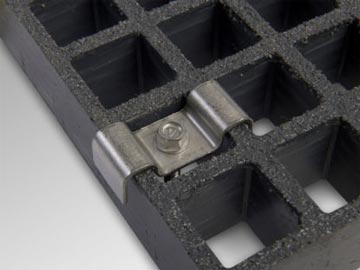
Type “M” Saddle Clip
Used to secure molded or pultruded panels to a support using two adjacent bearing bars. Bolt not included with standard clip order.
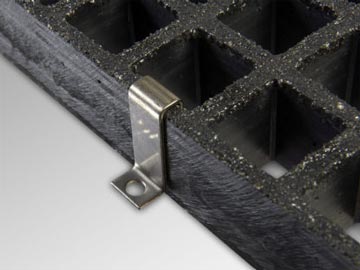
Type “J” Hold Down Clip
Used to secure molded grating to a support using one bearing bar. Bolt not included with standard clip order.
Type “F” End Panel Clip
Used to connect adjacent molded FRP Panels. Fastening bolt included with clip order.
Type “E” Hold Down Clip
Specifically designed to attach Ecograte62 molded grating to supporting structures. Bolt not included with standard clip order.
Type “FC” Hold Down Clip
Type “FC” clips are used to secure pultruded grating to adjacent supports. Bolt not included with standard clip order.
Type “G” Friction Clip
Used to attach molded or pultruded grating to support flanges that are less than ¾” thick. Type “G” Hold Down clips are a friction clip and do not require drilling into the support flange. Fastening bolt included with clip order.
Type W Clip
Used to secure covered grating or plate to supporting structures. Bolt not included with standard clip order.
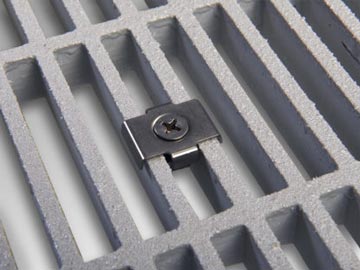
Type WLP Clip
Used to secure covered grating or close mesh FRP grating to supporting structures. Bolt not included with standard clip order.
To provide the best experiences, we use technologies like cookies to store and/or access device information. Consenting to these technologies will allow us to process data such as browsing behavior or unique IDs on this site. Not consenting or withdrawing consent, may adversely affect certain features and functions.
Functional
Always active
The technical storage or access is strictly necessary for the legitimate purpose of enabling the use of a specific service explicitly requested by the subscriber or user, or for the sole purpose of carrying out the transmission of a communication over an electronic communications network.
Preferences
The technical storage or access is necessary for the legitimate purpose of storing preferences that are not requested by the subscriber or user.
Statistics
The technical storage or access that is used exclusively for statistical purposes.The technical storage or access that is used exclusively for anonymous statistical purposes. Without a subpoena, voluntary compliance on the part of your Internet Service Provider, or additional records from a third party, information stored or retrieved for this purpose alone cannot usually be used to identify you.
Marketing
The technical storage or access is required to create user profiles to send advertising, or to track the user on a website or across several websites for similar marketing purposes.